These days it seems everyone (or every company with a social media presence) is jumping aboard the environmental train. It’s hard not to get cynical about how much these companies actually care, and how much difference is being made by supporting an “environmentally-friendly” company. We are hit from left, right and centre with heart-wrenching images of starving polar bears, lost orangutans and turtles suffocating on plastic straws.
But there’s something in Australia’s history that we could really learn from about social media:
The one image that has made its mark on the Australian national psyche and which is immediately recognisable even today, nearly forty years later:
Peter Dombrovski’s photo: Morning Mist, Rock Island Bend, Franklin River
This famous image is widely recognised as the factor that saved the Franklin River from the proposed Franklin River Dam in 1982. The dam was a hydroelectricity dam that would have impacted the Franklin River in the pristine wilderness of south-west Tasmania. The Wilderness Society ran full-page ads in national newspapers featuring the photo, with the caption, “Could you vote for a party that will destroy this?”
In 1981 a referendum was held as the Tasmanian State Labor government sought to compromise over the issue, giving the voters the option of a Gordon-below-Franklin dam or a Gordon-above-Olga dam. The option of no dam was withdrawn from the referendum, however 44% of the electorate cast an informal vote by writing ‘No Dams’ across their ballot form.
The following describes the events following the referendum:
The UN Sustainable Development Goal #15, Life on Land, aims to “protect, restore and promote sustainable use of terrestrial ecosystems, sustainably“. A key point raised in this goal is that “protecting important sites for terrestrial and freshwater biodiversity is vital for ensuring long-term and sustainable use of terrestrial and freshwater natural resources.”
In fact, the success of the No Dam movement is a reflection of the SDGs #16 (Peace, Justice and Strong Institutions) and #17 (Partnerships for the Goals), where the federal justice system ruled in support of the people who had come together in partnerships to achieve the conservation of a precious natural resource.
Would Peter’s photo have the same effect today? Have we become desensitised to these issues precisely because of images such as this that are prolific today on any social media site? Or was this image of the Franklin River so powerful because it wasn’t sensationalised at all, just a pure truthful view of the natural beauty of the area?
Perhaps in moving to innovative wastewater treatment systems to reduce water usage and increase water reuse, we could learn from Australia’s history and use social media without sensationalising or exaggerating, and so win over the support of an over-saturated society. If there was a clear image in people’s minds of the benefits of a sustainable wastewater treatment system perhaps they would be more willing to accept changes to the system. One last lesson from the Franklin Dam controversy is that the people really do hold the power and that if we want to make a difference, all we need to go is get together and go out and do it.
In Australia we are lucky enough that we can all take for granted that every time we turn on a tap in our house, no matter the time of day, the season, the political climate, clean fresh drinking water will come out and we will not get sick if we drink it. This is thanks to Australia’s legislation regulating water supply. We also take for granted that anytime we flush the toilet, wash dishes in the sink, take a shower, do the laundry, all that water will flow away and be treated to a high standard. This is also thanks to legislation in all states of Australia.
But how did we get to this comfortable point? And how do we continue to improve? Well that’s thanks to innovation.
Innovation in technology has allowed us to treat wastewater to a higher standard for cheaper. There are also innovative solutions to on-site wastewater treatment. On-site wastewater treatment designs in Western Australia have to be approved by the Department of Health, which has a list of approved designs on its website which include:
Precast concrete septic tanks
Glass fibre-reinforced plastic or plastic septic tanks
Waterless composting toilets
Secondary treatment systems (Including ATUs)
Greywater treatment systems
These designs must all meet Australian standards to ensure the health and safety of those on-site. Another page on the Department of Health’s website lists “alternative treatment solutions“. These are innovative designs that also meet the standards. There are only four that have been approved so far.
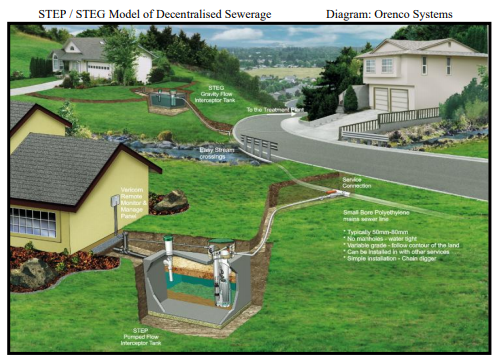
The below infogram is taken from a brochure for one of these approved innovative designs, showing how the wastewater is treated onsite.
But the majority of wastewater is not treated in such a way, and most of it is not reused. As global perceptions about wastewater change, Australia needs to keep up.
A good way for Australia to measure its performance in the wastewater sector is by following and aiming to achieve the UN Sustainable Development Goals.
The ninth UN Sustainable Development Goal, Industry, Innovation and Infrastructure has as one of its targets, “Enhance scientific research, upgrade the technological capabilities of industrial sectors in all countries, in particular developing countries, including, by 2030, encouraging innovation and substantially increasing the number of research and development workers per 1 million people and public and private research and development spending.”
Another target of the same goal is “By 2030, upgrade infrastructure and retrofit industries to make them sustainable, with increased resource-use efficiency and greater adoption of clean and environmentally sound technologies and industrial processes, with all countries taking action in accordance with their respective capabilities”. In order to achieve these targets, Australia needs to foster innovation in the wastewater industry, and then have legislation that allows for the implementation of innovative solutions. The only problem is that we really want to make sure people’s health and safety is still protected. So the result is a balancing act between legislation allowing for innovation whilst still being strict enough to enforce high standards.
But what about countries other than Australia? Well there is a great report published by the UN on its Sustainable Development Goal #6, Clean Water and Sanitation, which can be found here, titled “Progress on Wastewater Treatment”. This report is really interesting and shows how the UN and WHO are developing the methodologies to monitor progress in the goal #6.
Some of the aims of this goal include “By 2030, improve water quality by reducing pollution, eliminating dumping and minimizing release of hazardous chemicals and materials, halving the proportion of untreated wastewater and substantially increasing recycling and safe reuse globally” and “By 2030, expand international cooperation and capacity-building support to developing countries in water- and sanitation-related activities and programmes, including water harvesting, desalination, water efficiency, wastewater treatment, recycling and reuse technologies”.
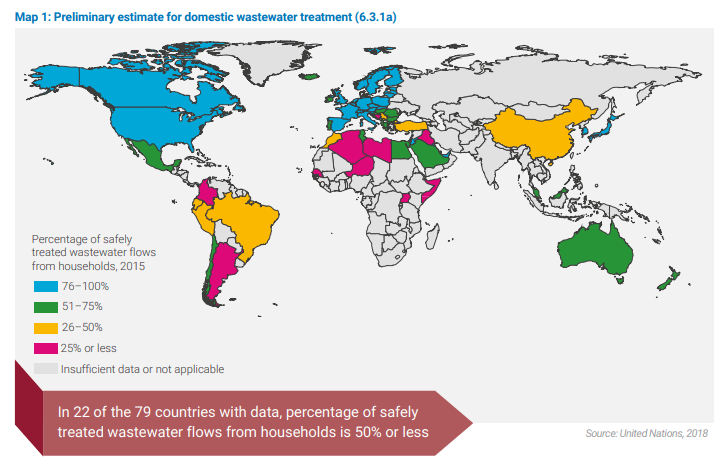
Map from “Progress On Wastewater Treatment”, UN 2018
The map above shows the percentage of safely treated wastewater flows from households in 79 countries. As can be seen in the map, some countries treat less than 25% of the wastewater from households. Possible reasons for such a low percentage of treatment is that it is not economically possible for these countries to create a wastewater treatment system. This is where innovation can come into play, and where wastewater engineers can make a huge impact. A great example of engineers being resourceful is the WASH program of Engineers Without Borders. This program aim “is for everyone to have access to safe and appropriate water and sanitation facilities and services they need for a healthy life free from poverty.” One ethical question that arises however is implementing treatment standards in a country where such standards do not exist. Even if such a standard does not exist, engineers have a responsibility to design and implement facilities that are as safe as possible for the general population.
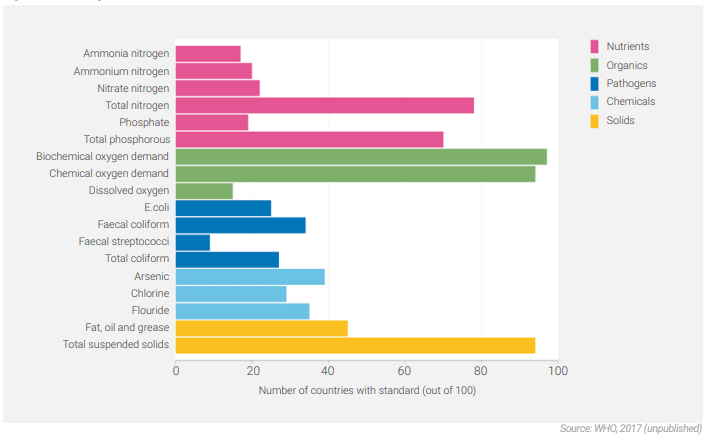
The figure below shows the percentage of countries with standards for different constituents in treated wastewater. Some countries have no standards for constituents I would consider very important, such as E. coli.
The “Progress on Wastewater Treatment” report makes an important suggestion about international legislation,
The UN Sustainable Development Goals provide a great framework for improving wastewater treatment practices globally, especially in considering the balance between legislation and innovation. I think that here in Australia we have quite good legislation but we could improve in our fostering of innovation to further improve our wastewater treatment.
The infrastructure of wastewater is something
that we all take for completely for granted! How many of us have actually
considered where any of the water that goes down the sink, down the shower
drain, or down the toilet actually goes? Personally, I used to just have a
vague idea of a pipe going to another pipe somewhere, to another pipe…
This ignorance is the bliss that being in a city in Australia affords us. But if you are from a more remote area of the country, your ideas of where the pipes go will be a whole lot more… solid. Providing wastewater infrastructure to remote communities around the world provides a huge logistical challenge and has massive potential for innovative engineering solutions.
Remote wastewater infrastructure??
Centralised, separated systems for wastewater and “clean” water are what is traditionally used in cities and towns: large networks of pipes leading to large wastewater treatment plants, totally separate from the other large networks of pipes of drinking water. These systems are totally impractical and too expensive for small, remote communities, who often therefore end up with a less-than satisfactory wastewater system.
In Australia, the most remote and smallest communities are Aboriginal communities and mining camps, each with their own particular challenges. Particularly in the northern areas of Australia, flooding can wreak havoc during the wet season, and systems need to be designed to deal with huge amounts of rain in very short periods of time. Mining camp wastewater treatment systems also need to deal with a population that wakes up at the same time, showers and uses the toilet at roughly the same time, so the peak input is much higher than in normal communities. Aboriginal communities face different challenges:
While this type of solution utilises industry and infrastructure, the infrastructure is not resilient, the community is not included, the system is not sustainable and there is no innovation. Is this the appropriate direction moving forward for remote wastewater systems- more centralised, separate? Shouldn’t we be looking towards decentralised, sustainable and integrated wastewater systems?
…but actually.
An Australian PhD student, Sarah West, took a year to do a study tour of innovative wastewater systems for remote communities around the world. Her report can be found here.
Sarah wrote “Through my studies it became clear that there may be a vast wealth of small scale or decentralised sewerage technologies specially designed to service small communities, which we in Australia were mostly unaware of. And not only would these systems be greatly cheaper to construct, operate and maintain, there would be a reduction in adverse environmental impacts, and also many environmental and social benefits.”
Her report includes detailed examinations of decentralised wastewater systems around Europe and the US, but she says the best practice system she found that was suitable for Australia was in Tennessee, U.S.A. Similar systems had been in use in New Zealand as well. The main components of these systems are:
wastewater source control
watertight collection units
watertight reticulation
advanced onsite treatment systems reconfigured to service a cluster/village/town
ultra-violet disinfection
effluent recycling and reuse
centralised management facilitated by remote monitoring.
In fact, these decentralised on-site systems provide so many varied benefits that they are being retrofitted on failed systems, fitted for expensive housing developments and new apartment blocks. The main roadblock is that people perceive traditional, centralised wastewater systems as providing:
I have no doubt that in the next few years we will start to see innovative wastewater infrastructure and systems in remote communities in Australia and fulfill the 9th Sustainable Development Goal.
Actually, definitely not eat it (disgusting) but we use it for agricultural and farming purposes!
The average person doesn’t think much more about what happens to the toilet contents after all your troubles are flushed away, but what follows is incredibly interesting and can have a hugely positive effect on soil quality in agriculture.
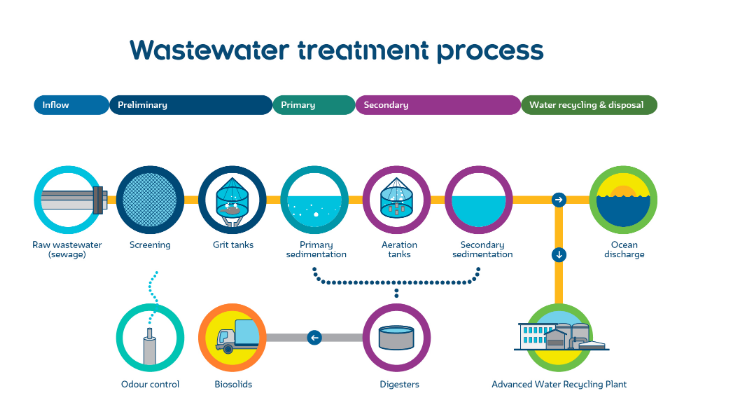
The schematic below shows the process wastewater goes through from raw sewage right through to being discharged into the ocean, recycled, or turned into biosolids.
Schematic of what happens to your wastewater
If, like me, you had never previously heard the word biosolid, allow me to introduce: Biosolids, treated sewage sludge that is a by-product of the processing of wastewater. Wastewater needs to be processed to remove any undesirable constituents or pathogens before it can be discharged into the environment.
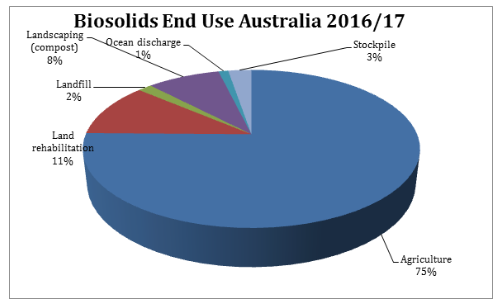
In 2017, Australia produced roughly 327,000 tonnes of dry biosolids. This equates to roughly 1.8 million tonnes of wet biosolids. So where does all this waste go?
As you can see, most of Australia’s biosolids go to agricultural uses. This is because the use of biosolids improves crop production. This use has been the subject of many studies in Washington, U.S. The results of these studies showed
Some agriculture in Australia has already jumped aboard the sludge train, and has seen a marked difference in soil quality, making a difference to how resilient farms are in drought stricken areas such as the central west of NSW. Farmers who used biosolids in certain paddocks saw an improvement in responsiveness of plants to any rain, no matter how little.
Another great impact of this use of biosolids is the reduction in reliance on chemical fertilisers.
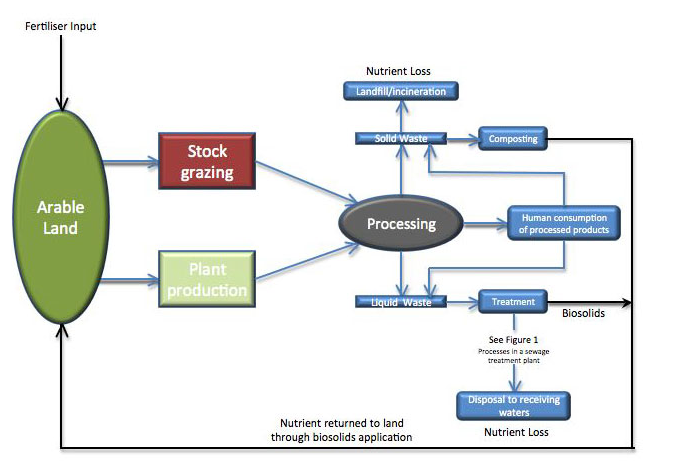
Schematic of nutrient flows in the urban context
The schematic above shows how the use of biosolids can reduce nutrient loss in arable land, and also the amount of fertiliser needed for farming. This represents not only an environmental bonus, but also a financial gain. One paper even claims that they calculated the “fertiliser substitution value of Australian biosolids to be of the order of $3 million/yr.”
Reducing the chemical runoff from fertiliser into surface and groundwater, as well as the stringent standards of biosolids meaning that there is no adverse effects to surface and groundwater both show how the use of biosolids as a replacement for fertiliser is in line with the Sustainable Development Goal 6 of the United Nations Development Program: Clean Water and Sanitation. In fact, arguably the use of biosolids could be seen to tackle all 17 goals.
Biosolids are an incredible resource in a country with a large agricultural industry and generally quite poor quality soils. It is great to see that we have taken large steps forward in utilising this widely available natural resource, rather than just flushing it away, but changing social attitudes is a slow process necessary for further advances in this area.
Have you
ever seen a truly “dark” night sky? A night sky with absolutely no light
pollution? For most of us, even in such a sparsely populated state as Western
Australia, the answer is no. What would life be like if we could step outside
our suburban house and see the Milky Way? What if there was no light pollution?
As this anecdote reveals, the true night sky
is not visible for many people for their whole life. “When a 1994 earthquake knocked out the power
in Los Angeles, many anxious residents called local emergency centres to report
seeing a strange “giant, silvery cloud” in the dark sky. What they were really
seeing—for the first time—was the Milky Way, long obliterated by the urban sky
glow.” (Chepesiuk, 2009)
Photo taken by Trevor Dobson
The photo
above was taken in Guilderton, WA. In it, the Milky Way is clearly visible. But
the light on the horizon behind the lighthouse is light pollution from Perth,
100km away.
We’ve all
heard of how light pollution is harming populations of animals such as turtles
and migratory birds. But did you know studies show that light pollution has
negative effects on human health? There is evidence that light pollution
increases obesity rates, and risk of cancer, depression and diabetes, through
interruption to our circadian rhythm. “Disruption of the circadian clock is
linked to several medical disorders in humans, including depression, insomnia,
cardiovascular disease, and cancer,” says Paolo Sassone-Corsi, chairman of the
Pharmacology Department at the University of California, Irvine. (Chepesiuk, 2009)
On top of
this, lighting has a “rebound effect”. Rather than using minimal lighting and
allowing our eyes to adjust to darkness, more lights are installed. These
lights make the darker areas look even darker, and so there is a need felt for
more lights, which make other dark areas look darker, and so on. The reduction
is power usage due to the advent of LED technology has been offset by the
increases in the number of lights. A reason for increased lighting comes from
the feeling that lit areas are safer. There is however, evidence to the
contrary. As Prof Travis Longcore, an assistant professor of architecture,
spatial sciences, and biological sciences at the University of Southern
California School of Architecture, explains,
“There is no conclusive evidence that
additional light reduces crime. In fact, there is some evidence that shows that
additional lights increase crime because criminals can see what they are doing.” (‘A boost in
light pollution’, 2017)
Not only
this, but in brightly lit areas, it is difficult to see anything that is in the
dark outside the lit area, increasing the ability for someone to lurk unseen.
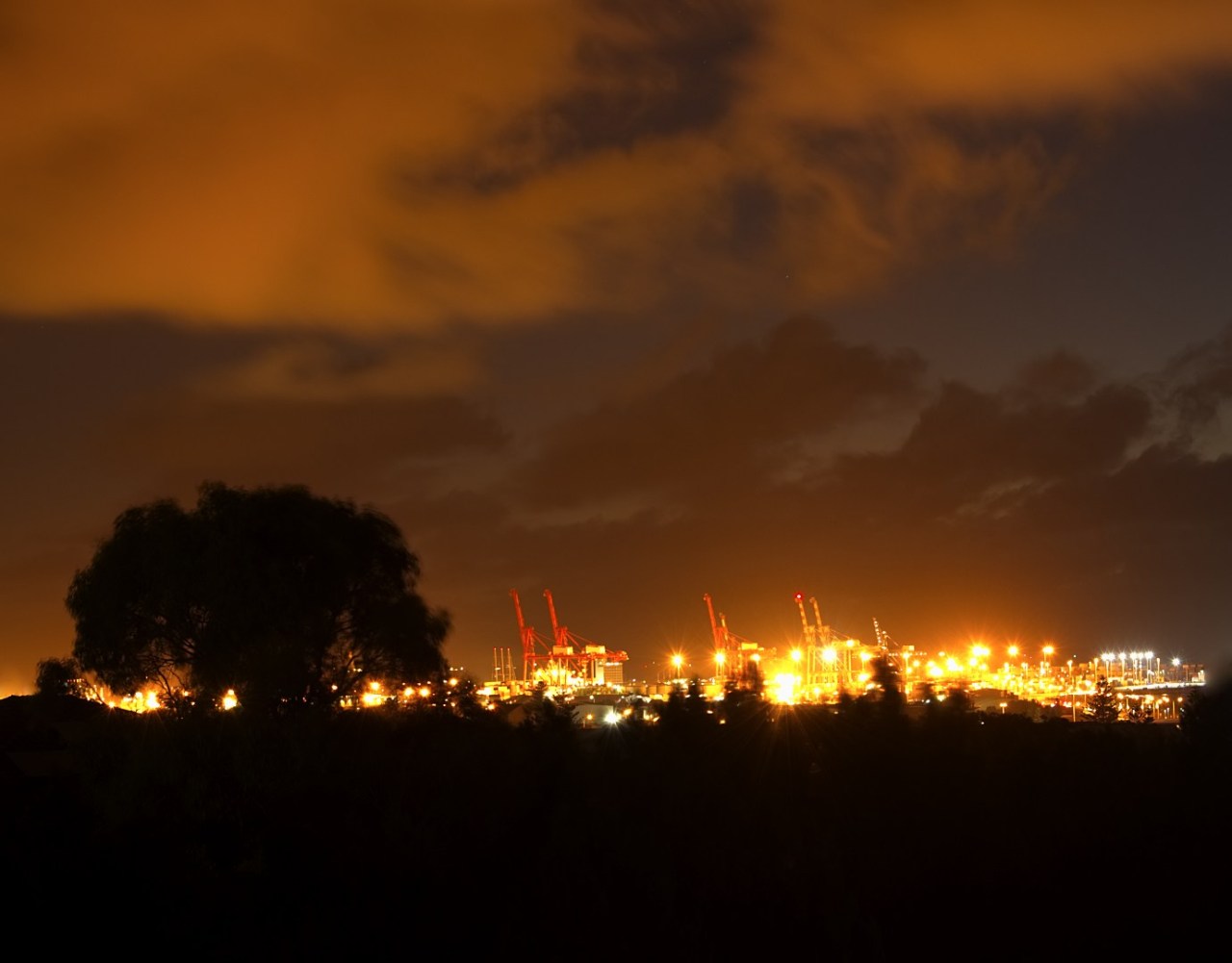
Ports
such as the Fremantle Port are large spaces brightly lit throughout the night. They
contribute a lot of light pollution to the night sky. Even when there are no
ships being loaded or unloaded, and no trucks coming into the port, every light
in the port remains on. Just have a look below for a photo of Freo Port taken
at night from a fair distance. Note the light reflected on the clouds above.
As recently as 6th March
2019, The Port of Fremantle announced new lighting was to be installed with
taller light poles in Rous Head including in areas which had previously been
unlit. This is not very environmentally friendly for a city such as Fremantle
which prides itself on being progressive, considering that a key solution to
reducing light pollution is keeping lighting as low to the ground as possible.
Reducing or even removing light
pollution from Fremantle Port has a multitude of benefits:
Reduction in
lighting costs
Health benefits
across the community, a reduction in diabetes, cancer and depression, which
also leads to reduced strain on public healthcare system
Fremantle keeps
its “green” badge and becomes a world leader in reducing light pollution
Crime rates
potentially decrease in the area
The City of Fremantle’s Strategic
Community plan for 2015-2025 includes a section on environmental responsibility.
In this section, there is an outcome listed: All City controlled buildings, activities and public places will be
more energy efficient. Another outcome listed: Better quality natural habitat with space for endemic biodiversity. Both
outcomes integrate with a goal of reducing light pollution and having a ‘dark
sky’ port.
Fremantle Port Authority claims that
“Fremantle led Australia’s entry into the container revolution 50 years ago”. (Fremantle
Ports, n.d.)
So why can’t Fremantle lead Australia’s entry
into dark sky ports today?
There have already been steps taken
(perhaps inadvertently) to reduce Fremantle Port’s light pollution with the
introduction of LEDs in the port. LEDs are a great power saving alternative to
traditional lights. However, the full potential of LEDs in reducing light
pollution has not been reached in Freo port.
I would like to propose three more
options for Fremantle to reduce its light pollution. These options are taken
from Yazi Fletcher, chief technical officer for US-based Phoenix Products
Company, in his article ‘Lighting up future port developments’ in Port Strategy: Insight for Port Executives.
Dimming controls- “A system can be installed that controls the
light output from 0% to 100% for certain areas that don’t require full
illumination all the time. Adjustments can easily be made for the time of day
or night and the type of activity occurring in the illuminated area.” (Fletcher, 2014)
Only having necessary lights on- “Traditional options require up to 20 minutes
of warm-up time following a restrike… For this reason, ports and terminals
often keep traditional lights on constantly throughout the night, making for
immense light pollution, light spill and subsequently wasted energy to illuminate
needless areas like the night sky and the open sea. With LED technology,
however, fixtures are instantaneously bright so they can be turned on and off
as much as needed with no reduction on the rated life of the light source. In
fact, they can even benefit from sporadic on/off cycles as the fixture remains
cooler over time.” (Fletcher, 2014)
Only incorporating LEDs on automated equipment
when the equipment is in transfer zones or where manual intervention is
required.
Why not just keep things the way they are
right now?
If Fremantle Port continues to be lit the way it is for the next twenty years,
or even to continue increasing its lighting at the rate it is today, it will be
known as being responsible for a lot of light pollution and therefore is increasing obesity rates, and risks
of cancer, depression and diabetes in Fremantle. So not only is the extra light
costing in terms of power, it is costing in the health of the community.
Compare this
to a Fremantle Port in a half century’s time being able to say that 50 years
ago, Fremantle led Australia’s entry into dark sky ports. With a noticeable
beneficial effect on community health, including mental health, vast benefits
for migratory and local animal populations, and a reduced power bill, Fremantle
will have lived up to its reputation as a progressive city.
Locally, the port reducing its lighting pollution will create community awareness of private light pollution. Through community engagement, people will notice unnecessary or poorly directed lights around their homes and will reduce their own contribution to light pollution. The health and other benefits of reduced lighting in the port will therefore snowball. Fremantle can then lead the way for the entire city of Perth to change its attitude toward light pollution.
It seems to
me that one of the biggest environmental issues at the moment is how we dispose
of our waste, be it waste as a by-product of resource extraction and refinement
(e.g. tailings dams), or end-of-lifecycle disposal of products. If you haven’t
seen it already, have a look at my latest video for a little look at what’s
been crossing my path recently.
The public
has recently been made more aware of what happens to our recycling when China
changed their thresholds for the quality of the recycling products they accept.
This had a major impact on the recycling industry in Australia. A really good
article if you’d like to know more about this can be found here: http://theconversation.com/chinas-recycling-ban-throws-australia-into-a-very-messy-waste-crisis-95522
Another
example of a major environmental crisis to do with waste products and their
disposal is the Ok Tedi tailings dam in Papua New Guinea. The Ok Tedi mine is a
copper gold mine that was opened by BHP in 1982. The tailings dam for this mine
failed during construction, leaving the tailings to run directly into the
waterways nearby. Tailings are by-products of the processing or refinement of
resources. Tailings of gold mines generally have high levels of cyanide, and
the Ok Tedi tailings also have high levels of copper. These waterways are the
lifeline for many communities downstream of the mine. BHP made the fateful
decision to continue mining and processing. These days, the mine is still in
operation, though it is no longer owned by BHP and has been taken over by the
PNG government, and the tailings are STILL going straight into the river… which
people are still using daily as drinking water, washing water, and fishing in.
Most of you
would have heard of the Great Pacific garbage patch, an accumulation of plastic
in the Pacific Ocean. Check out a youtube video I recently shared of plastic
washing up on the shores of a Dominican Republic beach. It might seem like a far-away problem for us
here on the edge of the Indian Ocean. In fact, there are large quantities of
plastic in our rivers and ocean here too. This plastic is from waste products:
plastic waterbottles that have been drunk and then disposed of, old
toothbrushes that get thrown in the bin, plastic bags, bait bags.
There are a
few things that we can personally do to reduce this kind of waste:
Don’t buy single-use plastic items, e.g. plastic water bottles, plastic cups, plastic cutlery, take-away in plastic containers. Do you really need that plastic straw in your iced coffee??
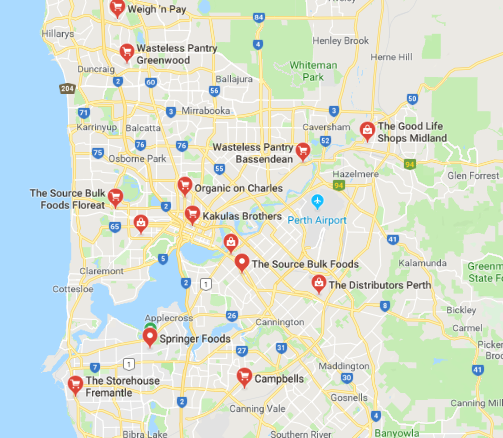
2. Avoid buying food wrapped in plastic. Don’t buy a bag of grapes in a plastic bag: get the loose bunch and put it in a reusable bag or a paper bag. There are also quite a few great shops opening around Perth which are bulk foods sellers: you bring your own containers and fill up on all kinds of things, from flour and chocolate to dishwashing liquid and washing powder.
Google maps snippet of bulk food store locations around Perth
3. Thirdly, and this should definitely go without saying, DON’T LITTER! Check out my new video blog if you want to see where your litter ends up ☹
4. Lastly, and this also makes financial sense, its better to save up to buy a quality product which will last rather than a cheaply made product which will have to be thrown out and replaced in a few months (I’m looking at you, Kmart toasters). This is not always the easiest option, but these days there are great ways to get second-hand quality products – op shops, Gumtree, Facebook barter pages, and some local councils have even created recycling centres for things which are too good to go to the tip and which could save someone some $$$.
These are
all great steps to take to reduce waste in the world, but surely there is an
even better solution to this waste problem…
I’d been
pondering this conundrum for a while, and then it hit me: in nature, there is no such thing as waste. Everything gets
“recycled”, reused, biodegrades. The
best way to manage waste disposal is to eliminate waste.
As a
society we need to move away from the possibility of single-use
non-biodegradable items. We can already see this movement in the ban on
single-use plastic bags, and more and more cafes are using either paper straws
or reusable straws.
“They’re as bad as drugs.”
Did you
know that in Rwanda, plastic bags are banned nation-wide? Not only that, but
possession of plastic bags could land you in prison.
“In Rwanda, the authorities say
the bags contribute to flooding and prevent crops from growing because
rainwater can’t penetrate the soil when it is littered with plastic. The
nation’s zero tolerance policy toward plastic bags appears to be paying off:
Streets in the capital, Kigali, and elsewhere across this hilly, densely
populated country are virtually spotless.”
– The New York Times, Public Shaming and
Even Prison for Plastic Bag Use in Rwanda, 2017
Not only
are plastic bags banned in Rwanda, but so is clingwrap and even certain
biodegradable bags, because they still take over a year to degrade.
Banning and enforcing restrictions seems like an easy (if slightly authoritarian)
route. But what about things that are essential? The answer is to look to nature,
in creating a design that has no waste.
It is impossible in nature to find something that once it reaches a certain
point becomes “waste”. Animal faeces becomes manure. Nutrients from a dead
animal feed bacteria and other smaller organisms. Creating products that do not
end their lifecycle as “waste” seems almost ludicrous, impossible even. And yet,
what a simple solution. Rather than banning, mitigating, offsetting, reducing,
recycling… why not just avoid creating a waste product from the beginning?
There are
hundreds of posts and sites telling you how to reduce waste in your home, but
to make a substantial difference, the change needs to be industry-wide, nationwide
and even global. No waste means a move toward natural materials which can
easily be repurposed or biodegrade. It means moving away from the business
models of tech companies such as Apple who purposely create items with short
lifespans, which are difficult to repair and quickly become obsolete. How many
of us have bought the latest iPhone only for it to stop working a few years
later? So how can we make this change come about? Well companies will follow
the consumer. If people en masse stop buying poorly designed disposable
products and instead begin to favour well made natural or durable products, the
shift will occur naturally. Of course, the key to this is an educated, informed
consumer. Therefore, public discussion, as well as actually having the option
of buying these types of products is paramount.








 Ecomate