Or more importantly, where is it all headed?
The infrastructure of wastewater is something that we all take for completely for granted! How many of us have actually considered where any of the water that goes down the sink, down the shower drain, or down the toilet actually goes? Personally, I used to just have a vague idea of a pipe going to another pipe somewhere, to another pipe…
This ignorance is the bliss that being in a city in Australia affords us. But if you are from a more remote area of the country, your ideas of where the pipes go will be a whole lot more… solid. Providing wastewater infrastructure to remote communities around the world provides a huge logistical challenge and has massive potential for innovative engineering solutions.
Centralised, separated systems for wastewater and “clean” water are what is traditionally used in cities and towns: large networks of pipes leading to large wastewater treatment plants, totally separate from the other large networks of pipes of drinking water. These systems are totally impractical and too expensive for small, remote communities, who often therefore end up with a less-than satisfactory wastewater system.
In Australia, the most remote and smallest communities are Aboriginal communities and mining camps, each with their own particular challenges. Particularly in the northern areas of Australia, flooding can wreak havoc during the wet season, and systems need to be designed to deal with huge amounts of rain in very short periods of time. Mining camp wastewater treatment systems also need to deal with a population that wakes up at the same time, showers and uses the toilet at roughly the same time, so the peak input is much higher than in normal communities. Aboriginal communities face different challenges:
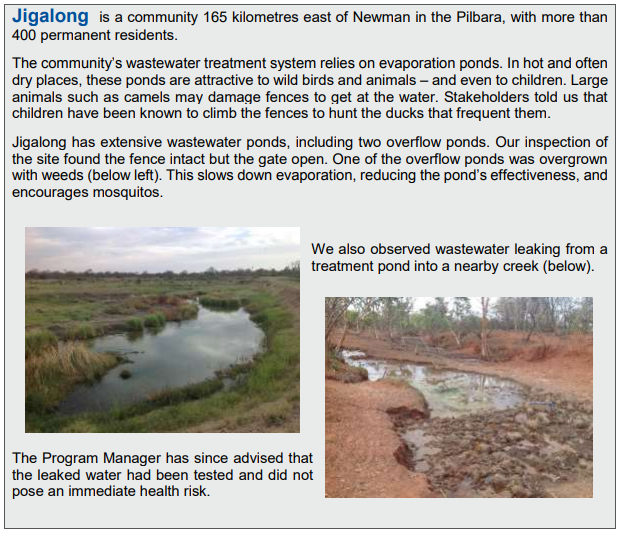
The UN Sustainable Development Goals website includes a page on HEALTH AND WATER IN REMOTE INDIGENOUS COMMUNITIES, linking this project to goals 3, 6, and 10: Good Health and Wellbeing, Clean Water and Sanitation, and Reduced Inequalities. I would argue however that these goals are not achievable without inclusion of goal 9: Industry, Innovation and Infrastructure. The aim of this goal is to “Build resilient infrastructure, promote inclusive and sustainable industrialization and foster innovation.”

The Health and Water in Remote Indigenous Communities report found that,
While this type of solution utilises industry and infrastructure, the infrastructure is not resilient, the community is not included, the system is not sustainable and there is no innovation. Is this the appropriate direction moving forward for remote wastewater systems- more centralised, separate? Shouldn’t we be looking towards decentralised, sustainable and integrated wastewater systems?

An Australian PhD student, Sarah West, took a year to do a study tour of innovative wastewater systems for remote communities around the world. Her report can be found here.
Sarah wrote “Through my studies it became clear that there may be a vast wealth of small scale or decentralised sewerage technologies specially designed to service small communities, which we in Australia were mostly unaware of. And not only would these systems be greatly cheaper to construct, operate and maintain, there would be a reduction in adverse environmental impacts, and also many environmental and social benefits.”
Her report includes detailed examinations of decentralised wastewater systems around Europe and the US, but she says the best practice system she found that was suitable for Australia was in Tennessee, U.S.A. Similar systems had been in use in New Zealand as well. The main components of these systems are:
- wastewater source control
- watertight collection units
- watertight reticulation
- advanced onsite treatment systems reconfigured to service a cluster/village/town
- ultra-violet disinfection
- effluent recycling and reuse
- centralised management facilitated by remote monitoring.
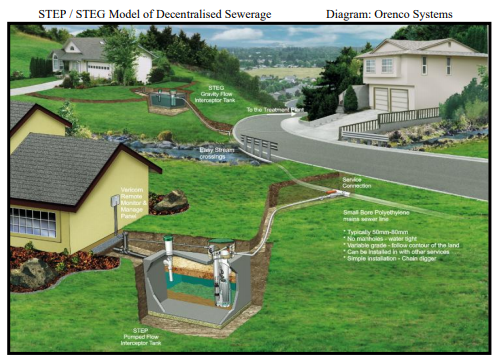
In fact, these decentralised on-site systems provide so many varied benefits that they are being retrofitted on failed systems, fitted for expensive housing developments and new apartment blocks. The main roadblock is that people perceive traditional, centralised wastewater systems as providing:
- freedom from uncertainty of performance
- freedom from householder responsibility
- predictable costs, and
- protection of public health.
According to Richard Otis, wastewater expert in the US, “If on-site and cluster systems are to be an accepted alternative, they must be managed in such a way as to be as invisible to the user as central sewerage.”
Another decentralised, integrated wastewater system for remote areas was investigated by researchers from Flinders University. They found a particular algae that could be used in small treatment ponds to clean the water. “The combination of speed and the chemical effect of algae in disinfecting wastewater make this system exceptional compared to contemporary models.” This system was 40% smaller than conventional treatment ponds, faster, cheaper, lost less water to evaporation, and could be managed at a community or household level.
I have no doubt that in the next few years we will start to see innovative wastewater infrastructure and systems in remote communities in Australia and fulfill the 9th Sustainable Development Goal.

 Ecomate