In Australia we are lucky enough that we can all take for granted that every time we turn on a tap in our house, no matter the time of day, the season, the political climate, clean fresh drinking water will come out and we will not get sick if we drink it. This is thanks to Australia’s legislation regulating water supply. We also take for granted that anytime we flush the toilet, wash dishes in the sink, take a shower, do the laundry, all that water will flow away and be treated to a high standard. This is also thanks to legislation in all states of Australia.

But how did we get to this comfortable point? And how do we continue to improve? Well that’s thanks to innovation.
Innovation in technology has allowed us to treat wastewater to a higher standard for cheaper. There are also innovative solutions to on-site wastewater treatment. On-site wastewater treatment designs in Western Australia have to be approved by the Department of Health, which has a list of approved designs on its website which include:
- Precast concrete septic tanks
- Glass fibre-reinforced plastic or plastic septic tanks
- Waterless composting toilets
- Secondary treatment systems (Including ATUs)
- Greywater treatment systems
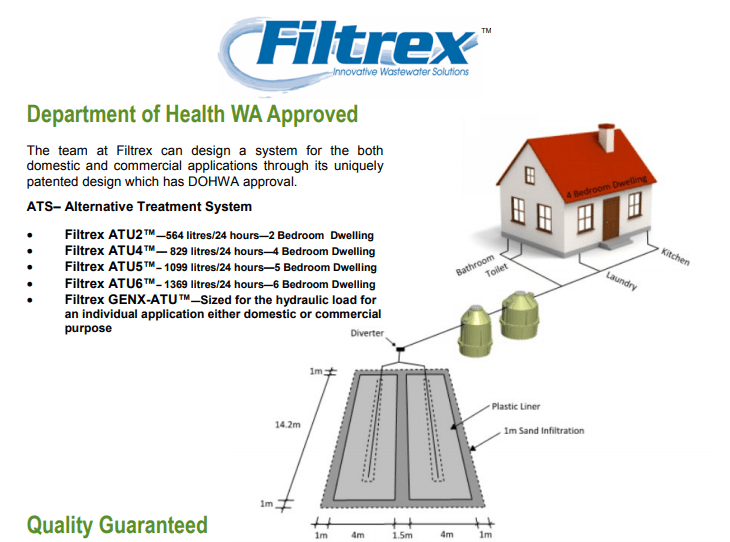
These designs must all meet Australian standards to ensure the health and safety of those on-site. Another page on the Department of Health’s website lists “alternative treatment solutions“. These are innovative designs that also meet the standards. There are only four that have been approved so far.
The below infogram is taken from a brochure for one of these approved innovative designs, showing how the wastewater is treated onsite.
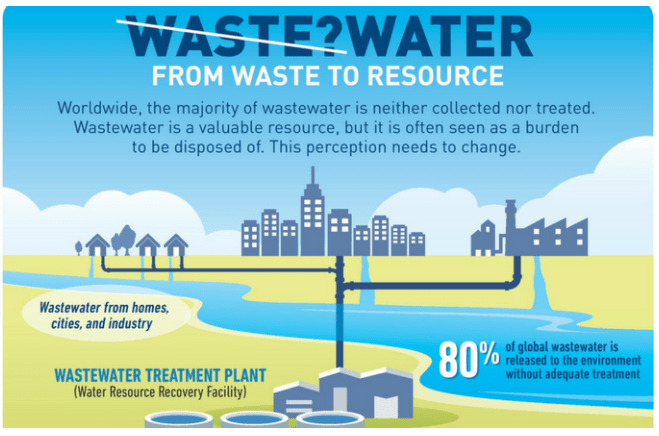
But the majority of wastewater is not treated in such a way, and most of it is not reused. As global perceptions about wastewater change, Australia needs to keep up.
A good way for Australia to measure its performance in the wastewater sector is by following and aiming to achieve the UN Sustainable Development Goals.
The ninth UN Sustainable Development Goal, Industry, Innovation and Infrastructure has as one of its targets, “Enhance scientific research, upgrade the technological capabilities of industrial sectors in all countries, in particular developing countries, including, by 2030, encouraging innovation and substantially increasing the number of research and development workers per 1 million people and public and private research and development spending.”
Another target of the same goal is “By 2030, upgrade infrastructure and retrofit industries to make them sustainable, with increased resource-use efficiency and greater adoption of clean and environmentally sound technologies and industrial processes, with all countries taking action in accordance with their respective capabilities”.
In order to achieve these targets, Australia needs to foster innovation in the wastewater industry, and then have legislation that allows for the implementation of innovative solutions. The only problem is that we really want to make sure people’s health and safety is still protected. So the result is a balancing act between legislation allowing for innovation whilst still being strict enough to enforce high standards.

But what about countries other than Australia? Well there is a great report published by the UN on its Sustainable Development Goal #6, Clean Water and Sanitation, which can be found here, titled “Progress on Wastewater Treatment”. This report is really interesting and shows how the UN and WHO are developing the methodologies to monitor progress in the goal #6.
Some of the aims of this goal include “By 2030, improve water quality by reducing pollution, eliminating dumping and minimizing release of hazardous chemicals and materials, halving the proportion of untreated wastewater and substantially increasing recycling and safe reuse globally” and “By 2030, expand international cooperation and capacity-building support to developing countries in water- and sanitation-related activities and programmes, including water harvesting, desalination, water efficiency, wastewater treatment, recycling and reuse technologies”.
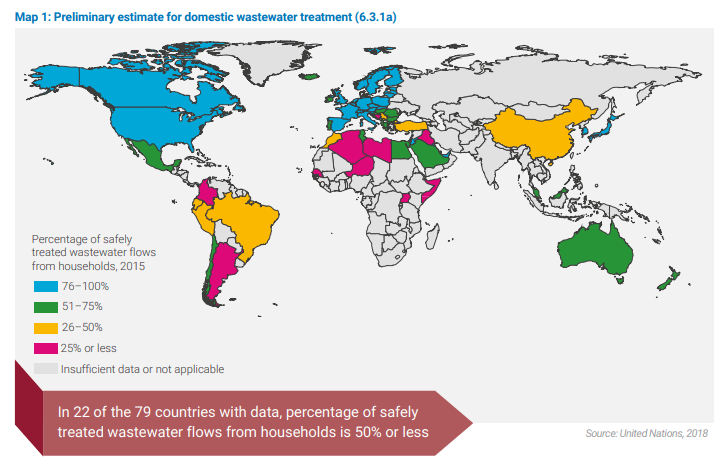
The map above shows the percentage of safely treated wastewater flows from households in 79 countries. As can be seen in the map, some countries treat less than 25% of the wastewater from households. Possible reasons for such a low percentage of treatment is that it is not economically possible for these countries to create a wastewater treatment system. This is where innovation can come into play, and where wastewater engineers can make a huge impact. A great example of engineers being resourceful is the WASH program of Engineers Without Borders. This program aim “is for everyone to have access to safe and appropriate water and sanitation facilities and services they need for a healthy life free from poverty.” One ethical question that arises however is implementing treatment standards in a country where such standards do not exist. Even if such a standard does not exist, engineers have a responsibility to design and implement facilities that are as safe as possible for the general population.
The figure below shows the percentage of countries with standards for different constituents in treated wastewater. Some countries have no standards for constituents I would consider very important, such as E. coli.
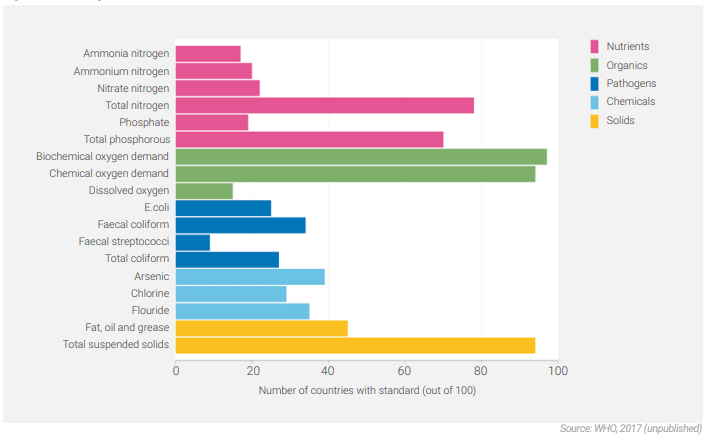
The “Progress on Wastewater Treatment” report makes an important suggestion about international legislation,
The UN Sustainable Development Goals provide a great framework for improving wastewater treatment practices globally, especially in considering the balance between legislation and innovation. I think that here in Australia we have quite good legislation but we could improve in our fostering of innovation to further improve our wastewater treatment.


 Ecomate