Does Waste Exist in Nature?
It seems to me that one of the biggest environmental issues at the moment is how we dispose of our waste, be it waste as a by-product of resource extraction and refinement (e.g. tailings dams), or end-of-lifecycle disposal of products. If you haven’t seen it already, have a look at my latest video for a little look at what’s been crossing my path recently.
The public has recently been made more aware of what happens to our recycling when China changed their thresholds for the quality of the recycling products they accept. This had a major impact on the recycling industry in Australia. A really good article if you’d like to know more about this can be found here: http://theconversation.com/chinas-recycling-ban-throws-australia-into-a-very-messy-waste-crisis-95522
Another example of a major environmental crisis to do with waste products and their disposal is the Ok Tedi tailings dam in Papua New Guinea. The Ok Tedi mine is a copper gold mine that was opened by BHP in 1982. The tailings dam for this mine failed during construction, leaving the tailings to run directly into the waterways nearby. Tailings are by-products of the processing or refinement of resources. Tailings of gold mines generally have high levels of cyanide, and the Ok Tedi tailings also have high levels of copper. These waterways are the lifeline for many communities downstream of the mine. BHP made the fateful decision to continue mining and processing. These days, the mine is still in operation, though it is no longer owned by BHP and has been taken over by the PNG government, and the tailings are STILL going straight into the river… which people are still using daily as drinking water, washing water, and fishing in.

Ok Tedi mine. Picture taken from: https://www.australianmining.com.au/news/ok-tedi-immunity-gone-with-implications-beyond-bhp/
Most of you would have heard of the Great Pacific garbage patch, an accumulation of plastic in the Pacific Ocean. Check out a youtube video I recently shared of plastic washing up on the shores of a Dominican Republic beach. It might seem like a far-away problem for us here on the edge of the Indian Ocean. In fact, there are large quantities of plastic in our rivers and ocean here too. This plastic is from waste products: plastic waterbottles that have been drunk and then disposed of, old toothbrushes that get thrown in the bin, plastic bags, bait bags.
There are a few things that we can personally do to reduce this kind of waste:
- Don’t buy single-use plastic items, e.g. plastic water bottles, plastic cups, plastic cutlery, take-away in plastic containers. Do you really need that plastic straw in your iced coffee??
2. Avoid buying food wrapped in plastic. Don’t buy a bag of grapes in a plastic bag: get the loose bunch and put it in a reusable bag or a paper bag. There are also quite a few great shops opening around Perth which are bulk foods sellers: you bring your own containers and fill up on all kinds of things, from flour and chocolate to dishwashing liquid and washing powder.
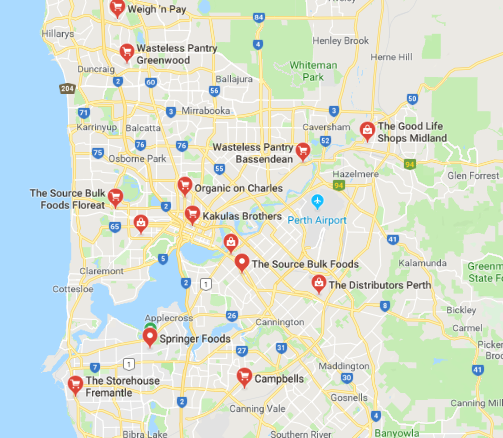
Google maps snippet of bulk food store locations around Perth
3. Thirdly, and this should definitely go without saying, DON’T LITTER! Check out my new video blog if you want to see where your litter ends up ☹
4. Lastly, and this also makes financial sense, its better to save up to buy a quality product which will last rather than a cheaply made product which will have to be thrown out and replaced in a few months (I’m looking at you, Kmart toasters). This is not always the easiest option, but these days there are great ways to get second-hand quality products – op shops, Gumtree, Facebook barter pages, and some local councils have even created recycling centres for things which are too good to go to the tip and which could save someone some $$$.
These are all great steps to take to reduce waste in the world, but surely there is an even better solution to this waste problem…
I’d been pondering this conundrum for a while, and then it hit me: in nature, there is no such thing as waste. Everything gets “recycled”, reused, biodegrades. The best way to manage waste disposal is to eliminate waste.
As a society we need to move away from the possibility of single-use non-biodegradable items. We can already see this movement in the ban on single-use plastic bags, and more and more cafes are using either paper straws or reusable straws.
“They’re as bad as drugs.”
Did you know that in Rwanda, plastic bags are banned nation-wide? Not only that, but possession of plastic bags could land you in prison.
“In Rwanda, the authorities say
the bags contribute to flooding and prevent crops from growing because
rainwater can’t penetrate the soil when it is littered with plastic. The
nation’s zero tolerance policy toward plastic bags appears to be paying off:
Streets in the capital, Kigali, and elsewhere across this hilly, densely
populated country are virtually spotless.”
– The New York Times, Public Shaming and
Even Prison for Plastic Bag Use in Rwanda, 2017
Not only
are plastic bags banned in Rwanda, but so is clingwrap and even certain
biodegradable bags, because they still take over a year to degrade.
Banning and enforcing restrictions seems like an easy (if slightly authoritarian)
route. But what about things that are essential? The answer is to look to nature,
in creating a design that has no waste.
It is impossible in nature to find something that once it reaches a certain
point becomes “waste”. Animal faeces becomes manure. Nutrients from a dead
animal feed bacteria and other smaller organisms. Creating products that do not
end their lifecycle as “waste” seems almost ludicrous, impossible even. And yet,
what a simple solution. Rather than banning, mitigating, offsetting, reducing,
recycling… why not just avoid creating a waste product from the beginning?
There are hundreds of posts and sites telling you how to reduce waste in your home, but to make a substantial difference, the change needs to be industry-wide, nationwide and even global. No waste means a move toward natural materials which can easily be repurposed or biodegrade. It means moving away from the business models of tech companies such as Apple who purposely create items with short lifespans, which are difficult to repair and quickly become obsolete. How many of us have bought the latest iPhone only for it to stop working a few years later? So how can we make this change come about? Well companies will follow the consumer. If people en masse stop buying poorly designed disposable products and instead begin to favour well made natural or durable products, the shift will occur naturally. Of course, the key to this is an educated, informed consumer. Therefore, public discussion, as well as actually having the option of buying these types of products is paramount.

 Ecomate
Your blog is great! I had no idea that Rwanda had such extreme views on minimising plastic wastage which is really interesting. I love how you provide simple advice on how to minimise wastage at home (all of which i am guilty of breaking except for point 3 whoops)
LikeLike
I’ve actually been thinking about looking for bulk food stores in Perth, I wasn’t are that there were so many already here and one just near me. I’d be keen to check it out thanks to your blog.
LikeLike
Thank you for including the map of stores around Perth that offer less packaging alternatives ❤
LikeLike
I love all the tips! They’re easy to understand and to put into practice! I think you’re totally right, we definitely need to move away from plastic. It’s choking our world and the only way we can even start to fix that is by implementing some of the strategies you’ve mentioned.
LikeLike